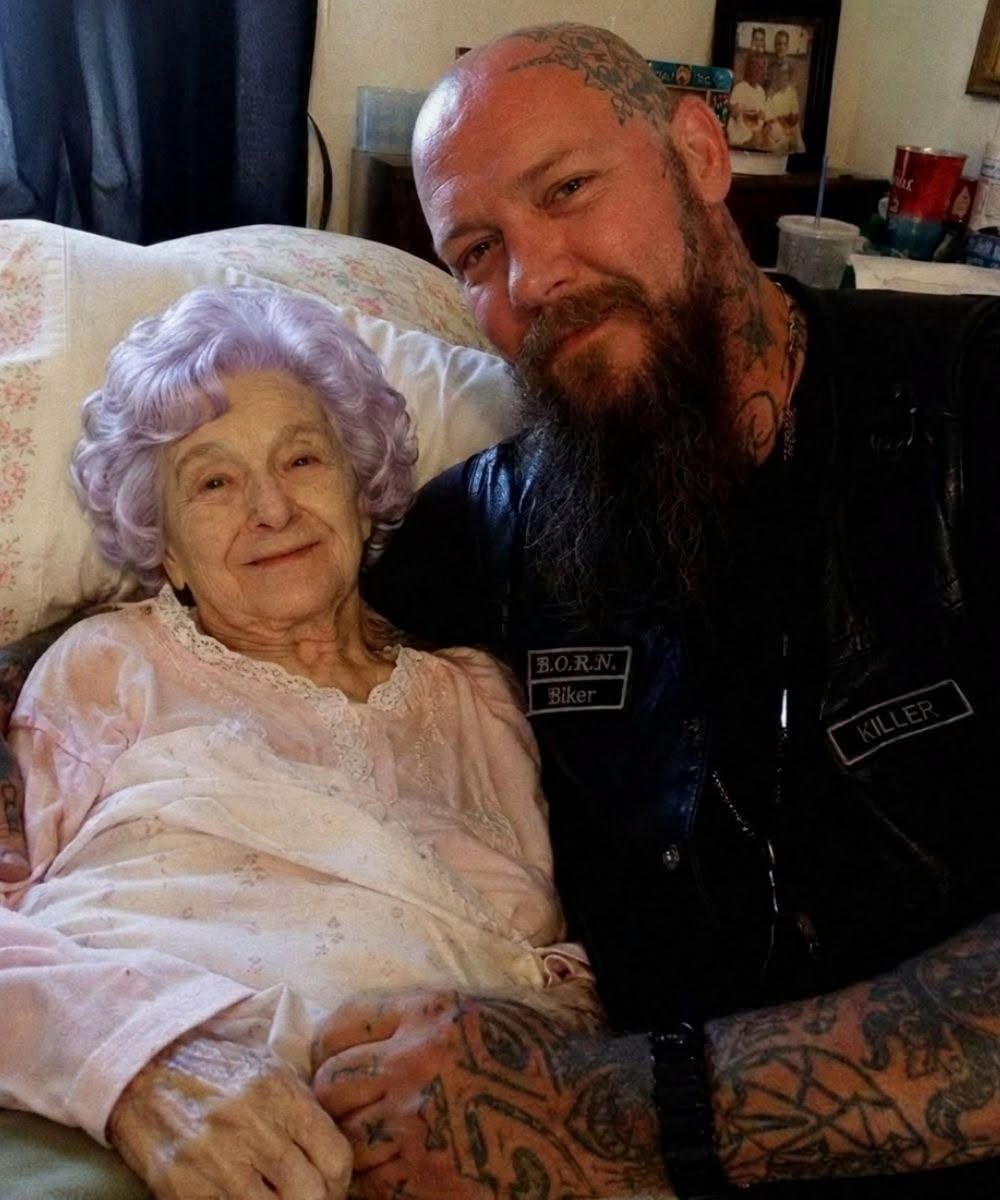
When my 81-year-old mother finally admitted she needed help, I expected her to hire someone quiet and conventional. She was still sharp and fiercely independent, but shopping, preparing meals, and getting to appointments had become exhausting. I wanted her to have reliable support. I was not prepared for the man who opened her front door when I came to visit.
Jack was tall and broad, with a heavy beard, tattoos running across his arms and up his neck, and a leather vest that made him look as though he had just stepped away from a motorcycle club. The sight of him standing in my mother’s hallway made me freeze. Before he had even said hello, I had already decided that something was wrong.
My mother introduced him as her caregiver. Jack spoke politely, asked whether I wanted coffee, and then returned to the kitchen to finish preparing her lunch. I pulled my mother aside and demanded to know where she had found him. She looked at me with the calm expression she had used throughout my childhood whenever I was being unreasonable.
“Watch what he does,” she said. “Then decide who he is.”
His actions contradicted every assumption I had made
Over the next several visits, I paid attention. The house was cleaner than it had been in months. Her medication was organized, fresh groceries filled the refrigerator, and every appointment was written clearly on the calendar. Jack never rushed her. He walked at her pace, listened when she repeated a story, and noticed when she was too tired to pretend she felt fine.
The biggest change was not in the house. It was in my mother. She laughed more. On difficult afternoons, Jack sat beside her instead of retreating to another room. He taught her how to make video calls, patiently explaining the same buttons until she could reach family without help. They looked through old photographs together, and he listened as if every name and memory mattered.
I eventually asked my mother why he was so devoted to her. She told me that years earlier Jack had lost people he loved and had withdrawn from almost everyone. He was struggling emotionally and keeping the world at a distance. On a rainy evening, they happened to meet at a community charity event.
Other people had judged him as quickly as I did. My mother had not. She welcomed him, offered him a place beside her, and started a conversation. She listened without staring at his tattoos or asking him to explain his appearance. When he spoke about grief and isolation, she encouraged him to keep moving forward. That evening did not magically erase his pain, but her kindness reached him when he believed nobody wanted to see beyond the outside.
He was returning a kindness he had never forgotten
They stayed in touch. When he learned that she was beginning to struggle at home, he volunteered to help. She insisted on calling him her caregiver, but he did not see their arrangement as an ordinary job. To him, it was gratitude in action. She had treated him with dignity when he needed it most, and now he wanted to protect hers.
I felt ashamed. I had walked through the door believing that I was protecting my mother, yet I had judged the person who was caring for her with extraordinary patience. His tattoos had told me nothing about whether he was dependable, compassionate, or trustworthy. His daily choices told me everything.
Jack did not need to fit my image of a caregiver to be the right person for my mother. He made sure she ate, took her medicine, reached her appointments, and never felt invisible. More importantly, he let her remain herself instead of treating her age as a reason to take away her voice.
My mother had hired the tattooed biker because she already knew the truth I still needed to learn. Character is not written on a person’s clothes, beard, or skin. It is revealed in how they behave when no applause is waiting. Jack remembered one act of kindness for years and answered it with loyalty, respect, and care. By the time I understood their bond, the man I had feared at the door had become someone I trusted beside the person I loved most.